
UAE’s Real GDP to Accelerate to 5.3% in 2026, Central Bank Says
The UAE’s real GDP is set to grow by 4.9% in 2025 and accelerate to 5.3% in 2026, according to the Central Bank of the UAE (CBUAE). This growth reflects strong performance in non-hydrocarbon sectors and a rebound in oil output supported by updated OPEC+ plans. In the first quarter of 2025, the UAE’s economy grew by 3.9% year on year. The non-hydrocarbon sector expanded by 5.3%, led by manufacturing, financial services, construction, and real estate. These sectors continue to drive the country’s economic diversification. Non-Hydrocarbon and Hydrocarbon Growth The CBUAE forecasts the non-hydrocarbon sector will grow by 4.5% in 2025 and 4.8% in 2026. Meanwhile, the hydrocarbon sector is expected to expand by 5.8% in 2025 and 6.5% in 2026. This balance underlines the UAE’s commitment to both energy and non-energy sectors. Inflation eased to 0.6% in Q2 2025, mainly due to lower energy costs. The central bank revised its 2025 inflation forecast downward to 1.5%, with a moderate rise to 1.8% expected in 2026. Banking and Financial Sector Resilience Liquidity remains stable, supported by strong deposit growth and sustained credit expansion. The UAE banking system is well-capitalized, with a capital adequacy ratio of 17.3% in Q2 2025. Asset quality improved as the net non-performing loan (NPL) ratio fell to 1.7%. Deposits rose 13.1% year on year, while loans expanded 11.1%. The insurance sector also strengthened, with gross written premiums up 14.5% in H1 2025. Capital ratios in insurance rose to 423% of minimum requirements, showing robust financial stability. Capital Markets and Real Estate Dubai and Abu Dhabi’s stock markets performed strongly. The Dubai Financial Market’s index surged 35.6% year on year, while Abu Dhabi’s index rose 8.1%. Low credit default swap spreads reflect investor confidence. Residential real estate sales increased 13.7% in the first five months of 2025. Off-plan sales rose 14.3%, and ready unit sales grew 12.5%. However, rental transactions in Dubai and Abu Dhabi fell 4.2%. Tourism and Aviation Tourism remains strong. Dubai welcomed 9.9 million international overnight visitors in H1 2025, a 6.1% increase from last year. Abu Dhabi and Dubai airports handled over 15.8 million and 46 million passengers, respectively, showing healthy aviation demand. Global Outlook and Monetary Policy The IMF forecasts global growth of 3.0% in 2025, with the US at 1.9% and the euro area at 1.0%. Emerging markets are projected to grow 4.1% in 2025, slowing slightly to 4.0% in 2026. The GCC region is set to outperform, with growth accelerating from 1.8% in 2024 to 3.5% in 2025, led by strong performance in the UAE and Saudi Arabia. Global inflation is expected to decline from 5.7% in 2024 to 3.6% in 2026. In line with the US Federal Reserve, the CBUAE maintained its base rate at 4.4% in July, lowering it to 4.15% recently. The dirham overnight rate (Donia) averaged 9 basis points below the base rate after introducing the overnight murabaha facility. Balance Sheet and Foreign Assets The CBUAE’s balance sheet expanded by Dh43.6 billion in Q2 2025, mainly due to higher net foreign assets. This supports the UAE’s financial stability and strengthens confidence in UAE’s real GDP growth prospects. With strong non-oil growth, resilient banking, and robust real estate and tourism sectors, the UAE is well-positioned for sustainable economic growth. Businesses seeking investment opportunities can rely on AR Associates for guidance and support in the UAE market. Contact AR Associates today to explore the potential of UAE’s growing economy.
Dubai Records Global Highest Number of Greenfield FDI Projects in Half-Year Since 2003

Dubai has set a global record by attracting the most Greenfield foreign direct investment (FDI) projects in a single half-year since 2003. In the first half of 2025, the emirate secured 643 Greenfield FDI projects. This is 478 more than the second-placed city and marks the highest number ever recorded worldwide in a half-year period. The achievement underlines Dubai’s growing role as a hub for international investment. Sheikh Hamdan bin Mohammed bin Rashid Al Maktoum, Crown Prince of Dubai, highlighted that this success aligns with the Dubai Economic Agenda, D33, which targets doubling the emirate’s economy by 2033. Strategic Location and Investment Appeal Dubai’s location at the crossroads of Asia, Europe, and Africa makes it ideal for global business. The city has built a strong investment ecosystem with clear regulations, modern infrastructure, digital-first services, and excellent global connectivity. This attracts companies looking for a safe and forward-looking destination. In the first half of 2025, Dubai ranked second globally for total Greenfield FDI capital, up from fourth in 2024. It also moved to third place globally for jobs created through inward FDI, an increase from fourth place last year. In both measures, Dubai remains the number one city in the Middle East. These results show the growing appeal of Dubai foreign investment across sectors. Growth in Headquarters and Emerging Sectors Dubai is also a preferred base for headquarters of multinational firms. The city secured the global top spot for HQ FDI projects, rising 60% from 20 projects in H1 2024 to 32 in H1 2025. The emirate leads in key sectors such as ICT and electronics, creative industries, professional services, life sciences, consumer goods, financial services, transportation, and environmental technology. Dubai is also a leader in emerging fields like Artificial Intelligence (AI) and Financial Technology (FinTech). With a global market share of 8% and 56% of the Middle East’s Greenfield FDI projects, Dubai has established itself as a major international investment hub. This highlights the continuing growth of Dubai foreign investment globally. Capital and Job Growth The Dubai FDI Monitor shows the emirate attracted Dh40.4 billion ($11 billion) in estimated FDI capital in H1 2025. This is a 62% increase from Dh24.7 billion ($6.8 billion) in H1 2024. The number of FDI projects rose 28.7%, from 847 to 1,090. Jobs created through inward FDI increased 46.7%, reaching 38,433 positions. Investment was diverse. Greenfield projects accounted for 52.4% of inflows, while new forms of investment made up 36.1%. Other contributions came from reinvestments (4%), venture capital (4.3%), and mergers and acquisitions (3.2%). Sectors included business services, consumer products, food and beverages, software and IT services, financial services, real estate, tourism, and transport. Sector and Function Distribution Business services led in capital inflows with 31.3%, followed by construction (28.6%), retail (10.7%), logistics and transportation (7.8%), and manufacturing (7.5%). In project numbers, retail dominated with 36.6%, then business services (30.7%), sales and support (21.3%), headquarters (2.9%), and logistics (2.4%). This spread shows investor confidence in Dubai’s ability to support diverse operations, from headquarters to logistics, manufacturing to retail. Leading Source Markets The top five countries contributed 68.7% of total FDI capital in H1 2025. The United States led with 35%, followed by the UK (10.6%), France (8.9%), India (8.9%), and Saudi Arabia (5.2%). For project numbers, the top five countries contributed 56%, led by the UK (16.2%), US (14.9%), India (14.9%), France (5.4%), and Italy (4.6%). Top Sectors by Capital and Projects The top five sectors accounted for 72% of total capital and 69% of total projects. Leading sectors by capital were business services (30.6%), hotels and tourism (21.3%), transportation and warehousing (7.2%), consumer products (6.6%), and real estate (6.3%). By project numbers, top sectors were business services (19%), consumer products (16.5%), food and beverages (15%), software and IT (11%), and financial services (6.6%). Dubai’s first-half performance in 2025 shows record-breaking Greenfield FDI, capital growth, job creation, and sector diversity. The city continues to stand as a global leader in Dubai foreign investment. Looking to invest in Dubai? AR Associates can guide your business through every step of setting up and expanding in the emirate. Contact AR Associates today to explore opportunities in Dubai foreign investment.
How to Apply for the UAE 10-Year Blue Residency Visa for Environmental Experts

The UAE has introduced the Blue Residency Visa, a 10-year permit for environmental experts. It aims to bring leading minds in sustainability, climate change, and energy to the country. This long-term visa supports the UAE’s push for stronger environmental, social, and economic growth. Who Can Apply? The Blue Residency Visa is open to individuals with proven impact in environmental work. Eligible applicants include: Applicants must show evidence of real contributions. This may include research papers, global awards, or documented work in major projects. Key Requirements Applicants need to prepare documents that prove their role in advancing environmental protection. Required items include: Additional documents may be required based on the applicant’s category, such as academic records or proof of investment in sustainability. Step 1: Apply for Nomination Before starting the visa application, a nomination is needed. Applicants can submit a nomination request through the Federal Authority for Identity, Citizenship, Customs and Port Security (ICP) at smartservices.icp.gov.ae. Step 2: Submit the Visa Application After receiving approval, you can move forward with the official visa process. Applicants inside the UAE must update their residency status. Applicants outside the UAE can apply for a six-month multiple-entry visa to complete procedures. This entry visa costs AED 1,250. During the application, you must provide: Supporting documents must be uploaded along with the visa service fee. Where to Apply Applications can be made through: Why the Blue Residency Visa Matters This visa is more than just long-term residency. It rewards individuals who dedicate their careers to protecting the planet. Holders can live and work in the UAE for 10 years, while contributing knowledge and skills to advance sustainability. The program also strengthens the UAE’s role as a global leader in climate action. By welcoming experts in green fields, the country builds capacity for renewable energy, sustainable development, and climate adaptation. Final Thoughts The UAE Blue Residency Visa is a major step in connecting opportunity with responsibility. For environmental experts, it offers a secure future in a country that values sustainability. If you are a scientist, researcher, or advocate in this field, prepare your documents and apply through the ICP platform. A decade-long residency in the UAE could be the next step in your journey to create lasting impact. Looking to apply with ease? Contact AR Associates for expert guidance on UAE Blue Residency Visa applications. Our team ensures your documents, nominations, and submissions are handled smoothly.
How to Register Your Management Consultancy Business in Dubai

Dubai is a major hub for consultancy services. The city’s strong economy, diverse industries, and global links make it ideal for management consultants. With more firms seeking expert advice, demand for consultants continues to grow. Setting up a consultancy here can be a smart move—if you follow the right steps. Why Register in Dubai? The consulting market in the UAE is one of the largest in the GCC. Reports show steady growth, with businesses across industries seeking expert guidance. For management consultants, this creates strong opportunities. Dubai also offers benefits such as: With these factors, many professionals consider business registration in Dubai a practical choice. What a Consultancy License Covers A management consultancy license allows you to provide a wide range of services. These may include: This flexibility makes it possible to serve clients across multiple sectors. Steps to Register Your Consultancy Starting a management consultancy requires planning and proper documentation. Here’s how the process works: 1. Define Your Business Structure Decide whether you want to set up on the mainland or in a free zone. 2. Choose a Trade Name Select a unique name that follows Dubai’s naming rules. Avoid offensive words or references to religion. 3. Submit the Initial Application Apply to the Department of Economic Development (DED) if setting up on the mainland, or to the relevant free zone authority. This stage involves outlining your planned activities. 4. Prepare Documents You will need: 5. Draft the Memorandum of Association (MOA) For mainland setups, you must sign an MOA that outlines company ownership and activities. Free zone setups may require standard incorporation documents. 6. Get Approval The relevant authority will review your documents. If everything is in order, you will receive approval to proceed. 7. Pay Fees and Receive License Once approved, pay the license fee. A digital copy of your consultancy license is issued, and the original can be collected later. Costs Involved The cost of registering a management consultancy in Dubai varies. Factors include business location, office space needs, and visa packages. On average, fees start from AED 15,000 but can be higher depending on setup. Visa Options As a license holder, you can apply for residency visas for yourself, family, and staff. The number of visas depends on office space and license type. Final Thoughts Dubai continues to attract consultants from across the globe. With high demand for management advice and a supportive business environment, the city offers long-term potential. By completing the steps for business registration in Dubai, consultants can unlock access to one of the region’s strongest markets. Whether on the mainland or in a free zone, the process is clear and achievable with the right preparation. Need help setting up your consultancy? AR Associates offers expert support for business registration in Dubai. From trade name selection to licensing and visas, Our team ensures a smooth and stress-free process.
How to Retire in Dubai and Apply for a 5-Year Expatriate Retirement Visa

Dubai is a top choice for retirees. The city offers safety, comfort, and a high standard of living. To support older residents, Dubai launched a 5-year expatriate retirement visa. This option gives long-term security for those wishing to stay. Who can apply Applicants must be at least 55 years old. They also need to meet one of several financial conditions. Meeting any one of these options allows you to apply. Required documents Applicants need to prove both age and financial eligibility. Common documents include: If applying from abroad, ensure official documents are translated into Arabic and attested. How to apply Applications are submitted through the General Directorate of Residency and Foreigners Affairs (GDRFA) in Dubai. The process usually involves: The visa is valid for five years and can be renewed if the applicant still qualifies. Benefits of retiring in Dubai The visa allows retirees to live in Dubai with peace of mind. They can access healthcare, maintain a local bank account, and sponsor family members under certain conditions. The city also provides world-class facilities, modern housing, and a strong sense of safety. For many, the 5-year retirement visa Dubai program means more than just legal residence. It opens the door to stable living in one of the most secure and vibrant cities worldwide. Final word Retiring in Dubai is now simpler thanks to clear eligibility rules and the dedicated visa program. With the right planning and documents, applicants can secure long-term residency and enjoy the city’s lifestyle without stress. The retirement visa Dubai system ensures that those who meet financial requirements can look forward to a stable future in the UAE. Need help with your retirement visa process? AR Associates provides expert guidance on eligibility, documents, and applications. Contact AR Associates today to make your retirement in Dubai smooth and secure.
How to Register Your Real Estate Business in Dubai
Dubai’s property sector continues to attract investors, brokers, and entrepreneurs. The city offers strong returns and a clear legal framework. If you want to start a real estate company here, the process involves several regulated steps. Step 1: Decide your business activity Real estate in Dubai covers different activities: brokerage, leasing and property management, consultancy, or development. Each has separate rules. For example, brokers must get approval from the Real Estate Regulatory Agency (RERA), while developers need to show capital reserves and open escrow accounts with the Dubai Land Department (DLD). Step 2: Choose mainland or free zone You can set up on the mainland or in a free zone. A mainland license lets you deal directly in Dubai’s property market without restrictions. A free zone license offers benefits like tax breaks and 100% ownership. But, to act as a broker in Dubai, you still need DLD and RERA approval even if registered in a free zone. Step 3: Reserve a trade name The Department of Economy and Tourism (DET) handles this. Your chosen name should not violate naming rules and must reflect your business activity. Once approved, you can move to initial registration. Step 4: Secure initial approval You’ll submit passport copies, visa pages, and business details. DET will confirm your activity is legal. This step clears the way for license application. Step 5: Lease an office space Real estate firms in Dubai must have a registered office. The lease must be recorded through Ejari, the tenancy registration system. RERA also requires a minimum office size for brokerages, usually starting from 200 square feet. Step 6: Prepare legal documents If you’re forming a company with partners, draft a Memorandum of Association (MOA). This defines roles, capital share, and responsibilities. The MOA must be notarized in Dubai. Step 7: Apply for a trade license Using your documents, apply through DET (mainland) or a free zone authority. The license must list your real estate activity, such as brokerage or consultancy. This is your legal right to operate. Step 8: Complete RERA training and certification Anyone working as a real estate broker in Dubai must pass RERA training. The Dubai Real Estate Institute provides this course. After passing the exam, you’ll get a Broker ID, which is mandatory for client dealings. Step 9: Register with DLD and Trakheesi Your company must be added to the DLD registry and Trakheesi system. Trakheesi permits are needed before advertising or listing properties. Without this, you cannot legally market real estate in Dubai. Step 10: Open a corporate bank account UAE banks require your trade license, MOA, office lease, and shareholder details. Expect compliance checks since real estate is a high-value sector. The process may take up to three weeks. Step 11: Hire staff and arrange visas Depending on office size and activity, you can apply for residency visas for staff and brokers. This includes Emirates ID, labor cards, and medical insurance. Costs to expect Initial setup can range from AED 45,000 to AED 100,000. Main expenses include trade license fees, RERA training, Ejari registration, and office rent. Annual renewals and marketing add to ongoing costs. Why Dubai is attractive Dubai’s real estate sector is well-regulated and transparent. Authorities like DLD and RERA maintain high standards, ensuring trust for investors and buyers. With clear steps for registration, entrepreneurs have a solid framework to operate and grow. Final word Setting up a real estate company in Dubai requires planning, approvals, and compliance. From trade licenses to RERA training, every step matters. By following regulations and securing the right structure, you can build a business that thrives in one of the world’s most dynamic property markets. Business Registration in Dubai is not only straightforward but also rewarding for those who prepare well. Partnering with experts in Business Registration in Dubai can further ease the process and ensure long-term success. Looking to register your real estate company in Dubai hassle-free? AR Associates offers end-to-end support, from licensing to RERA certification. Contact AR Associates today and launch your business with confidence.
Dubai vs. London: Why UK’s Wealthy Entrepreneurs Are Choosing the UAE
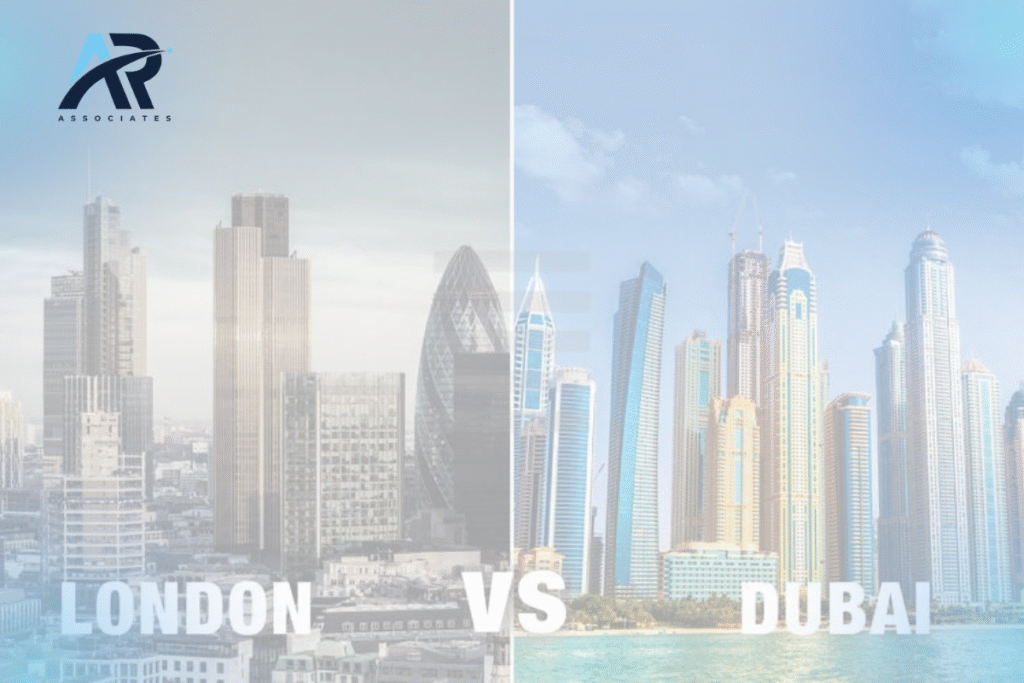
London has long been a magnet for the wealthy. But rising taxes, higher costs, and political uncertainty are driving many British entrepreneurs to look abroad. Increasingly, their destination of choice is Dubai. The Tax Factor The UK has seen talk of new wealth taxes and stricter rules for high earners. For entrepreneurs who want to protect their profits, this is worrying. In Dubai, there is no personal income tax. Company profits are not eaten away by government levies, allowing owners to reinvest more of their money. This difference alone is pulling business leaders from the UK to the UAE. Stability and Growth The UK economy has slowed in recent years, while inflation and policy shifts add pressure. Dubai, by contrast, has posted steady growth. Government reforms, major infrastructure projects, and strong global trade links make it one of the most stable places for investors. For business owners who want predictability, Dubai offers a clear edge. Residency Options The UAE has introduced visas that appeal to high-net-worth individuals. The Golden Visa allows long-term residency for entrepreneurs, investors, and their families. This means security and stability without the stress of short-term renewals. For UK citizens tired of Brexit complications and tighter immigration rules, this is a welcome change. Lifestyle and Location London is known for culture and heritage. But many entrepreneurs now prefer Dubai’s modern lifestyle. The city offers luxury housing, top-rated healthcare, and world-class schools. Its airport connects directly to Europe, Asia, and Africa, making it easy for global business owners to travel. The sunshine and safety are added bonuses that London struggles to match. Real Estate Appeal Property in London has become less attractive due to high prices and low rental yields. Dubai, on the other hand, offers strong returns. Rental yields average 6-8%, compared to London’s 3-4%. Properties are more affordable per square foot, yet still deliver high-quality living. For many entrepreneurs, this makes Dubai’s property market a smart investment as well as a lifestyle choice. Business Advantages Entrepreneurs find setting up companies in Dubai far simpler than in the UK. Free zones allow 100% foreign ownership and come with reduced red tape. The city is also positioning itself as a hub for technology, finance, and trade. With so many business opportunities in Dubai, it’s no surprise that wealthy founders see it as a natural base for expansion. The Bigger Picture This shift is not small. Reports show thousands of UK company directors have already moved abroad, many choosing Dubai. A growing number of British nationals are also among the top investors in Dubai real estate. Surveys reveal that over half of wealthy UK citizens would consider leaving if new taxes are introduced. Final Takeaway Dubai is competing with London not just as a business hub, but as a place to live, invest, and grow wealth. Tax relief, flexible visas, modern infrastructure, and profitable real estate make it highly attractive. For UK entrepreneurs who want to protect and grow their success, the UAE is no longer an alternative—it is becoming the first choice. Looking to explore business opportunities in Dubai? AR Associates can guide you through every step, from setup to growth. Contact us today and take your next move with confidence.
Get a Dubai Work Visa: Your Guide to Employment Authorisation
Dubai attracts thousands of professionals each year. High salaries, tax-free income, and a safe lifestyle make it a global hub for workers. But to legally work there, foreign nationals need proper authorisation. That means securing a work permit and a Dubai Work Visa. Work Permit vs. Work Visa Many confuse these two. A work permit lets an employer hire you. It is issued by the Ministry of Human Resources and Emiratisation (MoHRE). But the permit does not grant entry. For that, you need a work visa. The work visa acts as your entry ticket. It allows you to enter Dubai and start the steps needed for residency. Without both documents, you cannot legally work in the UAE. Types of Work Visas in Dubai Dubai offers several routes depending on your role and plans: Each category has its own requirements, costs, and processing times. Eligibility and Requirements To qualify, you need: Employers must also provide a valid trade license and submit an employment contract registered with MoHRE. The Application Process Here is how the process usually works: Processing can take one to two months. Costs vary by visa type, employer classification, and additional services. Costs to Expect The overall price usually falls between AED 3,000 and AED 7,500. This includes: Employers often cover these expenses, but not always. Clarify this before signing a contract. Free Zone vs. Mainland Employment Dubai has over 20 free zones. Each has its own rules. Companies in free zones can hire expats directly without a local sponsor. But their employees may be limited to working within that zone. Mainland visas allow work anywhere in the UAE but often require a local partnership. Why Dubai’s Work Visas Matter With 88% of its population made up of expats, Dubai relies on foreign talent. The visa system ensures workers are properly documented and protected under UAE labour law. Skipping the process or working on a visit visa is illegal and risks fines or deportation. Final Thoughts Securing a Dubai Work Visa is the first step toward building a career in one of the world’s fastest-growing cities. Whether you’re a skilled employee, a freelancer, or an investor, there is a pathway tailored to your needs. Preparation, accurate documentation, and following official procedures are the keys to success. Need expert guidance with your Dubai Work Visa? AR Associates is here to simplify the process and ensure a smooth, hassle-free experience. Contact us today to get started!
Dubai Real Estate Market Shatters Records with Historic AED66.8 bn of Transactions in May 2025, Property Finder Reveals

Dubai’s property market has reached a new high. In May 2025, sales hit AED66.8 billion across more than 18,700 deals, according to Property Finder. This is the highest monthly transaction value ever recorded in the emirate. A Record-Breaking Month Transaction value jumped 44% compared to May 2024. Volume also grew 6%, showing that demand remains strong. Both off-plan and ready property sales drove growth. Primary ready sales reached AED17.9 billion from 2,400 transactions. That’s a 314% rise in value and 145% in volume over last year. Secondary ready sales also set a record at AED24 billion across 6,078 transactions, reflecting steady end-user and investor demand. The Role of Off-Plan Properties Off-plan deals continue to power growth. In May 2025, off-plan sales crossed AED37 billion, up 65% year over year. Developers have launched a range of projects targeting both luxury buyers and mid-market segments. Communities like Business Bay, Wadi Al Safa 3, and Al Barsha recorded strong activity. A standout deal was a land transaction in Palm Deira worth AED1.5 billion, a signal of confidence from institutional investors. Apartment Demand Remains High Consumer data shows that apartments remain the most searched property type. In May, 78% of rental searches and 60% of buyer interest were for apartments. One-bedroom units led both rental and purchase searches, reflecting lifestyle and investment preferences. Studios attracted more renters than buyers, suggesting they appeal mainly to budget-conscious tenants. Buyers lean toward larger layouts for long-term use or rental yields. Why the Market is Booming Several factors support this surge: These trends highlight Dubai’s ability to sustain growth while offering steady returns. Hotspots for Investors Business Bay drew high-value buyers, capturing 5% of total transaction value with only 3% of volume. Al Barsha showed wide appeal, representing 5% of deals across different price points. Such diversity in activity suggests there are many UAE investment opportunities for both short-term gains and long-term holdings. Luxury properties also performed well, supported by demand from international investors seeking secure assets in a strong market. Looking Ahead Property Finder’s analysts expect momentum to continue through the year. Demand from new residents, combined with steady foreign investment, is likely to push activity further. For buyers and investors, the numbers prove that Dubai’s market is not slowing down. The combination of luxury demand, affordable housing interest, and large-scale land deals points to lasting growth. Conclusion May 2025 was a milestone month for Dubai’s real estate sector. With AED66.8 billion in transactions, it set a new benchmark and reinforced the city’s global standing. For investors, the market continues to present unmatched UAE investment opportunities, from prime urban apartments to landmark land deals. Ready to secure your place in Dubai’s booming real estate market? Connect with AR Associates today for expert guidance on the best investment opportunities tailored to your goals.
How to Register Your E-Commerce License in Dubai/UAE

Starting an online store in Dubai or the UAE requires the right license. The government has made the process structured but flexible, allowing entrepreneurs to set up with clarity. This guide explains the key steps to register your e-commerce license. Why You Need an E-Commerce License An e-commerce license is a legal permit to sell goods or services online. Without it, operating an online store in Dubai can result in penalties. The license also gives credibility when dealing with banks, suppliers, and customers. Step 1: Choose Mainland or Free Zone The first step is deciding where to register. Free Zones such as Dubai Internet City or Dubai CommerCity are popular for online businesses. The right choice depends on your business model and target customers. Step 2: Pick a Trade Name Your trade name must follow UAE naming rules. Avoid religious words, offensive terms, or names of countries. The name must be unique, clear, and registered with the Department of Economy and Tourism (DET) or the Free Zone authority. Step 3: Apply for the License For Mainland registration, apply through the DET. For Free Zone, apply directly with the chosen authority. You’ll need: Step 4: Get Your Visa Once your license is approved, you can apply for a residence visa. Owners, staff, and dependents may all be sponsored. The number of visas depends on office space and business size. Step 5: Open a Corporate Bank Account Banks in the UAE require your license before opening an account. Documents usually include your license, shareholder details, and projected turnover. Having a business account makes transactions smooth and secure. Costs Involved The cost of an e-commerce license depends on whether you choose Mainland or Free Zone. Fees usually range between AED 10,000 and AED 20,000. Extra costs may apply for visas, office space, and bank account setup. Benefits of Registering in Dubai Dubai is a strong choice for online businesses because of: The UAE e-commerce sector is projected to cross USD 8 billion by 2025. Registering now means tapping into a fast-growing market with room for expansion. Key Difference: E-Trader vs. E-Commerce License An E-Trader license suits small businesses selling from home through social media. An E-Commerce license is for larger businesses selling through websites or across borders. Choosing the right one depends on scale and growth goals. Why Seek Professional Help While the steps are clear, paperwork and approvals can take time. Many entrepreneurs choose a business setup firm to speed up the process. These experts handle applications, trade name checks, and bank introductions. Using a service provider can reduce delays and help avoid costly mistakes during Company Formation UAE. Final Thoughts Registering an e-commerce license in Dubai is straightforward if you follow the right steps. From picking the right jurisdiction to opening a bank account, each step builds the foundation for a legal and trusted business. Dubai’s market is growing quickly. With the right structure in place, your online business can scale both locally and globally. Partnering with experts in Company Formation UAE can make the process faster and more reliable. Ready to launch your e-commerce business in Dubai?AR Associates specializes in business setup services that simplify licensing, banking, and visas. Get expert guidance and start your online business the right way. Contact AR Associates today to begin your registration.